

Rear bike racks are a practical way to carry bags, commuting essentials, or touring gear without loading your back or handlebars. The right choice depends less on a single feature and more on how the rack fits your bike, how much weight you plan to carry, and what kind of riding you do.
If you are comparing options for daily errands, bikepacking, or longer rides, it helps to focus on mounting style, clearance, and the shape of your cargo setup. Rear racks can look similar at a glance, but the details make a big difference in fit and convenience.
Compare Rear Bike Racks


As an Amazon Associate we earn from qualifying purchases.
What should you look for in a rear bike rack?
Start with compatibility, then compare how the rack will support your load and how it will sit on your bike. A rack that fits your frame poorly can be more frustrating than one with extra features you do not need. The most useful choice is usually the one that matches your bike’s mounting points, tire and frame clearance, and the bags or cargo you expect to carry.
Specifications vary by model, so always check the individual product page before buying.
| Feature | What It Means | Why It Matters | What To Check |
|---|---|---|---|
| Mounting style | How the rack attaches to the bike frame or axle area | Determines whether the rack fits your bike securely | Look for matching mounting points and any frame or axle requirements |
| Load support | The kind of cargo the rack is meant to carry | Affects stability and how practical the rack is for daily use or longer trips | Compare the rack design with the bags or items you plan to carry |
| Clearance | Space around the rear wheel, fender, and drivetrain | Helps avoid interference with the tire, brakes, or accessories | Check space for your tire size, fenders, and rear gear setup |
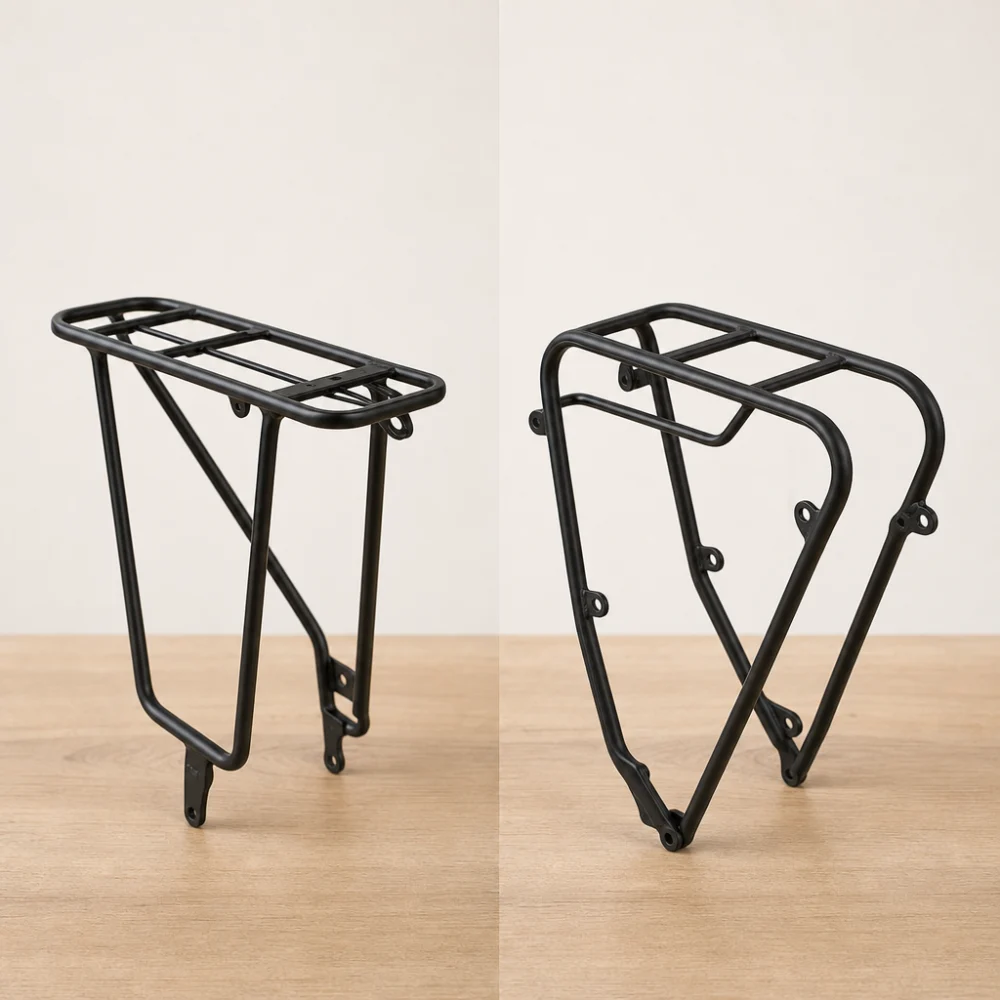
| Platform shape | Whether the top of the rack is flat, raised, or shaped for certain bags | Changes how easily cargo sits and how secure it feels | Think about panniers, strapped bags, or a mixed setup |
| Attachment points | Places where bags or extra gear can connect | Improves everyday convenience and load control | Look for hooks, rails, or top space that matches your carrying style |
Key decision criteria
Fit to your bike
Fit is the first decision because it affects everything else. Some bikes have dedicated mounting points, while others need a rack design that works differently. A good match should sit straight, clear the wheel, and leave enough room for brakes, fenders, and other rear-end hardware.
How you plan to carry cargo
Think about the kind of load first. Commuters often want a stable place for bags, while touring riders may care more about consistent support over long distances. If you mainly carry light items, a simpler rack may be enough; if you carry heavier or irregular cargo, sturdier support and better tie-down options matter more.
Rack shape and everyday use
Some racks are easier to use with panniers, while others are better for items strapped on top. The shape affects how quickly you can load and unload, how low the weight sits, and whether the rack feels balanced when fully loaded. If you switch between work gear, groceries, or bikepacking luggage, versatility can matter more than a specialized design.
Weight and handling trade-off
Any rear rack adds hardware to the bike, so it is worth thinking about how much extra bulk you want. A rack that supports more gear may also be heavier or more noticeable when riding unloaded. If you ride mainly for fun and only occasionally need cargo space, a lighter or simpler setup may feel better.
Common rear rack types and variants
Rear bike racks are usually compared by how they attach and how they carry cargo, rather than by dramatic feature differences. A standard rack is often aimed at general utility use. A touring-style rack may prioritize steadier long-distance carrying. Some designs are better suited to panniers, while others emphasize a top platform for strapped-down items.
The main limitation is that a rack built for one use case may not be the most convenient for another. If you want one setup for commuting, errands, and occasional travel, favor a rack that leaves you flexibility instead of optimizing for only one cargo style.
Which rear rack suits which rider?
| Buyer need | Helpful rack characteristics | Why that matters |
|---|---|---|
| Daily commuting | Easy bag attachment, stable fit, and simple loading | Makes errands and work trips less awkward |
| Bikepacking or touring | Secure mounting and a setup that supports repeated use | Helps keep gear organized over longer rides |
| Occasional cargo hauling | Versatile design and straightforward installation | Lets you add carrying capacity without overcommitting to a large system |
| Budget-conscious replacement | Basic compatibility and only the features you will use | Avoids paying for complexity you do not need |
Common mistakes to avoid
- Choosing by appearance alone. A rack can look like it will fit, but small differences in mounting and clearance determine whether it works on your bike.
- Ignoring the cargo style. A design that is ideal for panniers may be less convenient for strapped items, and the reverse is also true.
- Overlooking rear-end clearance. Tires, fenders, and drivetrain parts can affect fit even when the rack seems close on paper.
- Buying more rack than you need. A larger or more complex rack can add weight and bulk that is unnecessary for light errands.
Safety and suitability caveats
Rear racks are useful, but they should be chosen for the specific bike and load in question. A rack that is not intended for your frame style or cargo type may be awkward or unsuitable even if it seems close. It is wise to confirm fit details, load expectations, and any accessory compatibility before buying.
If you plan to carry valuable, unstable, or unusually heavy cargo, pay extra attention to how the rack and bags work together. The safest choice is the one that matches the intended use rather than trying to cover every possible scenario.
Maintenance, storage, and long-term use
Rear racks are usually low-maintenance, but they do benefit from periodic checking, especially if you ride often or carry heavier loads. Look for signs that fasteners need attention and make sure the rack still sits straight after regular use. If you ride in wet or salty conditions, basic cleaning can help the hardware stay in good condition.
Think about storage too. A rack that is removable may be easier to keep on hand for occasional use, while a fixed setup is simpler for everyday riding. The right choice depends on whether you value convenience, flexibility, or a more permanent cargo setup.
How to compare rear bike rack options efficiently
- Identify the main job: commuting, touring, errands, or occasional cargo.
- Check whether your bike has the right mounting points and clearance.
- Compare the rack shape with the kind of bags or cargo you plan to use.
- Think about convenience, weight, and how often you will remove or adjust it.
- Read the individual product page carefully before deciding.
Rear bike rack buyer checklist
- Does the rack match your bike’s mounting setup?
- Is there enough clearance for the wheel, fender, and drivetrain?
- Will the rack work with the bags or cargo you actually plan to carry?
- Does the rack shape suit commuting, touring, or mixed use?
- Is the setup simple enough for the level of convenience you want?
- Have you checked the individual product page for model-specific details?
Frequently asked questions
Do rear bike racks fit every bike?
No, not automatically. Fit depends on the frame, mounting points, wheel size, brake setup, and clearance around the rear wheel. Always confirm compatibility on the individual product page before buying.
Should I choose a rack for panniers or a top platform?
That depends on what you carry most often. Panniers are useful for balanced side loading, while a top platform can be handy for strapped cargo or quick everyday hauling. Some riders prefer a rack that supports both styles.
What matters more: strength or weight?
It depends on your use. If you carry heavier or frequent loads, sturdier support may matter more than shaving off extra hardware weight. If you only need occasional cargo space, a simpler setup may feel better on the bike.
Can I use a rear rack for bikepacking?
Yes, if the rack is designed to work with the way you plan to pack your gear. Bikepacking setups often benefit from stable attachment and a layout that keeps bags secure over rougher rides. Check the rack design carefully rather than assuming any rear rack will do.
Is installation usually permanent?
Not always. Some racks are meant to stay on the bike, while others are easier to remove when you do not need them. The better choice depends on whether you want everyday convenience or occasional flexibility.
What is the main thing shoppers overlook?
Clearance is often overlooked. A rack can seem suitable until you account for fenders, tire width, brakes, or other rear accessories. That is why it is worth checking the full setup, not just the rack itself.
More Rear Bike Racks
See all 92 Rear Bike Racks →



As an Amazon Associate we earn from qualifying purchases.