

A two-person backpacking tent is a shared shelter intended to balance room for two sleepers with the weight and packed size hikers need to carry. The category covers different layouts and setup styles, so the capacity label alone does not tell you how comfortably a particular tent will fit two people and their gear.
Start with the trips you expect to take and the space each person needs. Then compare the tent’s dimensions, carried weight, setup requirements, and stated conditions of use against your priorities.
Compare Two-Person Backpacking Tents


As an Amazon Associate we earn from qualifying purchases.
What should you prioritize in a two-person backpacking tent?
Choose based on the actual sleeping space and how much of the shelter’s weight each person will carry, not just the two-person label. Check whether the floor shape and dimensions suit both sleepers and their pads, and whether there is a practical place for gear. Balance those needs against packed size, setup style, and the conditions the maker says the tent is intended for. Specifications vary by model, so always check the individual product page before buying.
Compare the features that affect your choice
| Feature | What It Means | Why It Matters | What To Check |
|---|---|---|---|
| Floor dimensions and shape | The sleeping area’s length, width, and layout | Two people may fit differently depending on their pads and how the floor tapers | Floor measurements, shape, and dimensions of the sleeping pads you plan to use |
| Interior height and doors | Room to sit up and enter or leave the sleeping area | Can affect comfort when sharing the tent, especially during time spent inside | Peak height, door arrangement, and how access works for both occupants |
| Vestibule and gear space | Covered space outside the inner sleeping area, when included | May help keep packs and other gear out of the sleeping area | Whether a vestibule is included and whether its size and access suit your gear |
| Weight and packed size | How much the shelter weighs and how compact it is when packed | Both affect what you carry and how easily the tent fits with other equipment | Which components are included in the stated weight and packed dimensions |
| Setup style | How the tent is supported, such as by its own poles or trekking poles | Different designs can call for different equipment and campsite conditions | Required poles, stakes, and other components, plus the maker’s setup requirements |
| Intended conditions | The conditions and seasons the maker describes the tent for | A shelter suited to one kind of trip may not suit another | The maker’s stated use, weather-related information, and any relevant limitations |
| Included components | What comes with the tent, such as a footprint or stakes | Missing or separately selected items can affect what you need to carry | Included items and any compatibility guidance for components you may add |
How to choose the right tent for your trips
Check whether the sleeping area fits two people
Compare the floor dimensions with the size and arrangement of the pads you and your companion use. A stated two-person capacity does not guarantee extra room for bags, clothing, or moving around. A tapered floor can also feel different from a more evenly shaped one, even when a listed measurement looks generous.
Balance shared weight against packed size
For a shared tent, the people carrying it may divide components between their packs. Check the stated weight and what it includes rather than assuming every listing uses the same basis. Packed dimensions matter too if your packs have limited room or you carry other bulky equipment.
Consider access and space for gear
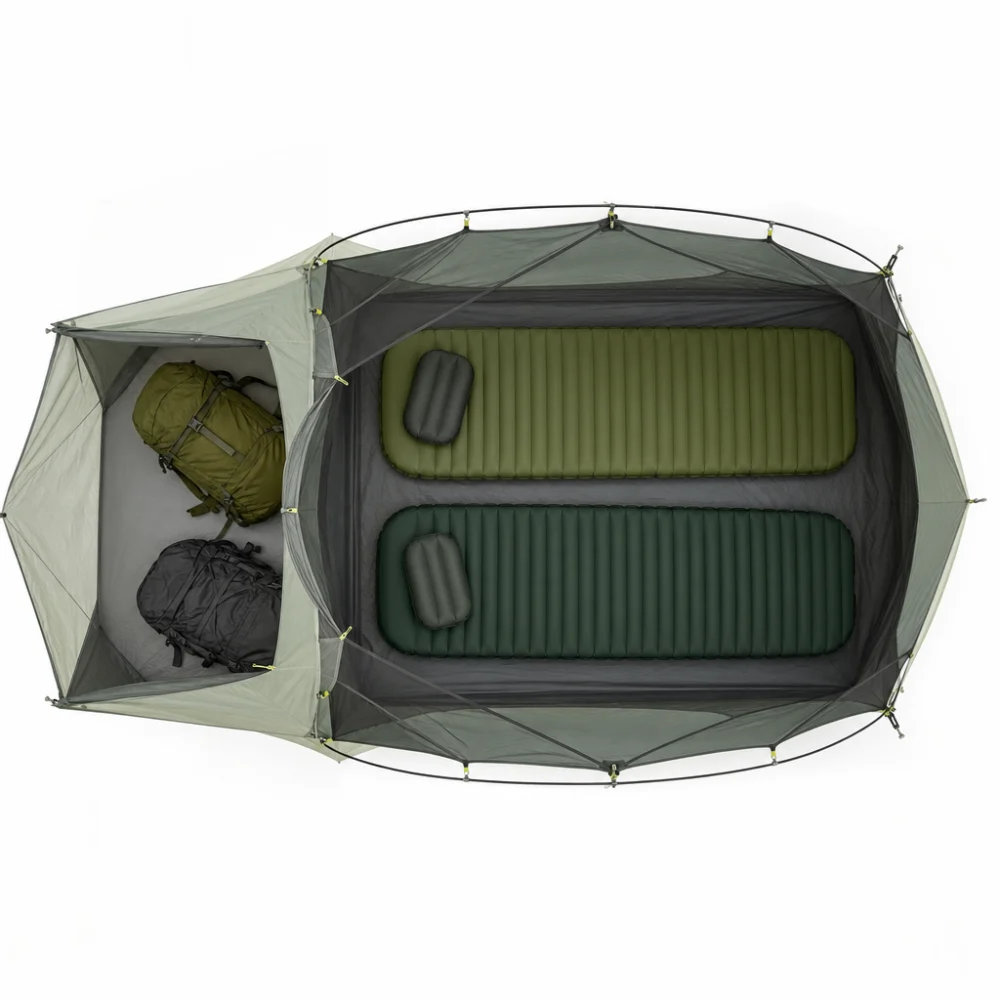
Separate doors may make it easier for each person to get in and out without disturbing the other, but the useful arrangement depends on how the tent is laid out. A vestibule, when present, may provide a place for gear outside the sleeping area. Check its dimensions and access rather than assuming that a two-person tent has substantial storage space.
A simple top-down layout can help you compare the sleeping area with the space available for gear. Think about the pads and packs you actually plan to bring; an illustration is only a planning aid, not a measurement of any specific tent.
Match the setup design to your equipment and campsites
Some tents use dedicated poles, while other designs rely on trekking poles or another support arrangement. A design that uses gear you already carry may appeal to some hikers, but confirm what is required and whether the setup suits the places where you expect to camp. Freestanding designs and designs that need stakes or suitable anchoring can differ in how they accommodate a campsite; check the maker’s stated requirements.
Read intended-use information carefully
Look for the maker’s description of intended conditions and any stated limits. A season label by itself does not establish that a tent is suitable for every trip in that season. Choose with the likely conditions and the shelter’s stated use in mind.
Types and design variations
Within two-person backpacking tents, useful differences include support style and interior layout. Freestanding designs use their own pole structure; other designs may depend on trekking poles or stakes for support. Neither approach is automatically right for every hiker: compare required equipment, campsite flexibility, and setup preferences.
Layouts also vary in doors, vestibules, floor shape, and usable interior space. Focus on those details rather than assuming that tents with the same capacity label will feel alike. Broader labels such as ultralight or season designations should be assessed using the individual tent’s stated details and intended use.
Choose according to how you will share the tent
| If you prioritize | Look closely at | Trade-off to consider |
|---|---|---|
| Room to sleep comfortably as a pair | Floor shape and dimensions, pad fit, and access | More space can affect the weight or packed size you carry |
| Keeping gear out of the sleeping area | Vestibule layout and usable gear space | A vestibule’s presence does not by itself establish how much gear it can accommodate |
| Sharing the carry between hikers | Total stated weight and which components can be carried separately | Check what the weight includes before planning how to divide it |
| Using trekking poles as part of your kit | Whether the design requires poles and which other supports are needed | A design that depends on particular equipment may be less suitable if you do not carry it |
| Camping in varied conditions | Stated intended use, construction details, and limitations | A general label cannot replace checking the maker’s information for your intended trip |
Common buying mistakes to avoid
- Relying on the capacity label alone: Compare the floor dimensions and shape with the pads and sleeping arrangement you plan to use.
- Comparing weights without checking what is counted: Confirm which tent components are included in the stated figure before deciding how much each person will carry.
- Assuming gear storage is included or spacious: Check whether the tent has a vestibule and review its layout and dimensions.
- Overlooking required supports: Confirm whether the design needs specific poles, trekking poles, stakes, or other components.
- Treating a season label as a guarantee: Read the stated intended use and limitations, then consider whether they fit the trips you have in mind.
- Assuming a footprint or other accessory is included: Check the included-components list and any maker-provided compatibility information.
Safety and suitability
Choose a tent for the conditions and use described by its maker, and do not treat a category name or season label as a guarantee of protection. Consider the weather and campsite conditions you expect, and check any stated limitations before buying. If your plans may involve conditions beyond the tent’s described use, look for a shelter expressly suited to those needs.
Ownership, care, and storage
Care and storage requirements can vary by model. Review the maker’s directions for cleaning, drying, packing, and storage, and check whether any separately selected groundsheet or accessory is compatible. Following the product-specific guidance helps you understand what ownership involves without assuming every tent uses the same materials or care routine.
A practical buying process
- Write down who will share the tent, the pads you use, and the kinds of trips you expect to take.
- Decide which matters most: sleeping space, lower carried weight, compact packing, access, or a particular support style.
- Compare floor layout, doors, vestibule details, stated weight, and packed dimensions.
- Check required supports, included components, intended conditions, and stated limitations.
- Review the individual product information against your priorities, including the trade-offs you are willing to accept.
Buyer checklist
- Will the floor shape and dimensions suit both sleepers and their pads?
- Can each person access the tent in a way that works for your shared setup?
- Is there a vestibule or other suitable place for the gear you plan to bring?
- What components are included in the stated weight, and how will you carry them?
- Does the setup style require equipment you already carry or plan to bring?
- Do the maker’s stated intended use and limitations match your expected trips?
- Are any footprint or other accessories included, and is compatibility stated?
Frequently asked questions
Does a two-person tent always fit two adults comfortably?
Not necessarily. Capacity labels do not describe every detail of usable space, so compare the floor shape and dimensions with the pads and sleeping arrangement you plan to use. Check doors and interior layout as well.
Is a two-person tent a good choice for one person?
It can be worth considering if you prefer more room, but the additional space may come with weight or packed-size trade-offs. Compare those details with a one-person tent and your carrying priorities.
What is the difference between a freestanding tent and one that uses trekking poles?
Freestanding designs use their own pole structure, while some other designs rely on trekking poles or other supports. Check the equipment each tent requires and the maker’s setup information before choosing.
Should two people split the tent’s components between their packs?
That can be a practical way to share a shelter’s carry, but first check the full stated weight and which components are counted. The product information may also help identify components that can be carried separately.
Do I need to buy a footprint separately?
That depends on what is included with the specific tent and what the maker recommends. Check the included-components list and any compatibility information rather than assuming a footprint is supplied or required.
Can a season rating tell me which weather a tent can handle?
A season label alone is not enough to determine suitability for every condition. Read the maker’s intended-use description and limitations, and match them to the conditions you expect on your trips.
Ventilation and condensation
Ventilation can affect comfort in a shared tent, especially when two people occupy a compact sleeping area. Compare the placement and adjustability of vents and the amount of mesh in the design, then consider whether those features suit the conditions you expect. More airflow may be useful in some conditions, while a more enclosed interior may better match other preferences; check the specific design rather than assuming all tents ventilate alike.
Condensation can form when moisture inside a tent meets cooler surfaces, and the amount can depend on conditions as well as the shelter’s design. Do not treat a ventilation feature or material description as a guarantee that condensation will not occur. Check the maker’s information about ventilation and intended use, particularly if you expect humid or variable conditions.
How should I compare tent ventilation?
Look for where vents are placed, whether they can be adjusted, and how the inner and outer parts of the shelter are arranged. Consider how two people will use the sleeping space and whether the design’s ventilation features fit your likely camping conditions. Product descriptions vary, so compare the details for each tent rather than relying on a general label.
More Two-Person Backpacking Tents
See all 102 Two-Person Backpacking Tents →


As an Amazon Associate we earn from qualifying purchases.