

CO2 inflators use a compressed-gas cartridge and an inflator head to add air to a bicycle tire. They are designed to be compact, which can appeal to riders who want an emergency inflation option without carrying a larger pump.
The right choice depends on more than size: the head must suit your valve and cartridge, and the cartridge must be appropriate for your tire setup. Consider how you will carry and replace cartridges, too, since they are consumables.
Compare CO2 Inflators


As an Amazon Associate we earn from qualifying purchases.
What should you look for in a CO2 inflator?
Start with compatibility: confirm the head works with your valve type and with the cartridge format you intend to carry. Then compare how the inflator controls gas release, how easy it is to carry, and whether cartridge capacity suits your tire volume and intended use. The trade-off is convenience versus dependence on compatible, single-use cartridges; a traditional pump does not need a replacement cartridge after use.
Compare the important buying factors
| Feature | What It Means | Why It Matters | What To Check |
|---|---|---|---|
| Valve compatibility | The head connects to one or more bicycle valve types. | A mismatch can prevent the inflator from fitting your tire valve. | Confirm compatibility with the valve on your bicycle and whether an adapter is needed. |
| Cartridge format | Cartridges may differ in attachment style, including threaded and unthreaded formats. | The head must accept the cartridge you plan to carry. | Check the inflator’s stated cartridge compatibility; do not assume every cartridge fits. |
| Cartridge capacity | Cartridges differ in the amount of compressed gas they contain. | The amount needed depends on tire volume and the inflation goal. | Use the product information and your tire requirements to judge suitability rather than relying on a general rule. |
| Release control | Some designs provide a way to regulate or stop gas release. | Control can help manage inflation, while simpler designs may prioritize a straightforward interface. | Look for clear information about how the head controls release and whether that suits your experience. |
| Carry and handling design | The head and any included protective features affect how the inflator is carried and handled. | A compact setup is easier to pack, but small parts may be less convenient to handle. | Review the listed dimensions, included components and handling guidance for the specific product. |
Key factors to consider before buying
Match the inflator to your valve
Check the valve fitted to your bike before choosing a head. Some inflators support more than one valve type, while others may require a separate adapter or be intended for a particular interface. Confirm the exact compatibility stated for the individual product rather than inferring it from a photo or a broad category label.
Check cartridge fit and capacity
Threaded and unthreaded cartridge formats are not automatically interchangeable, so confirm that the head accepts the cartridge you plan to carry. Capacity also matters: tire volume and the pressure you need influence how much gas is appropriate. Specifications vary by model, so always check the individual product page before buying.
Consider release control
A head with a release-control feature may suit riders who want more control over gas delivery. A simpler head may appeal to someone who values a less complicated design. Compare the stated controls and instructions, and choose a style you can use confidently rather than assuming every head works the same way.
Think about what you will carry
The inflator head is only part of the setup. Consider the space for the head and compatible cartridges, whether a protective sleeve or other component is included, and how you plan to carry them. Check included-items information carefully; a listing for an inflator does not by itself establish that a cartridge is included.
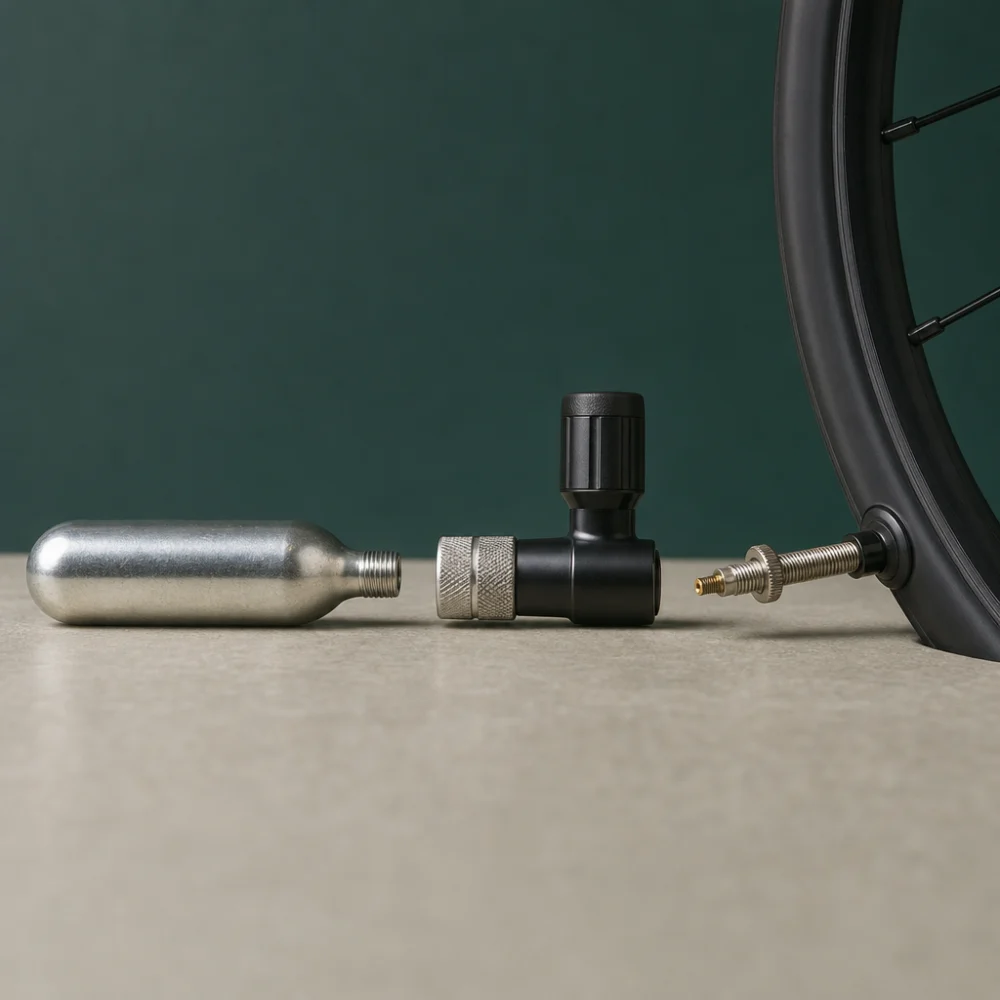
A generic inflator head connects a compatible cartridge to a bicycle valve; the cartridge attachment and valve interface are separate compatibility checks.
Types and variations
- Heads with release control: These provide a stated method for controlling gas release. They may suit riders who prefer to manage delivery, but buyers should check the specific control design and instructions.
- Simpler-release heads: These use a more basic release approach. They may be appealing for a straightforward setup, though they offer less adjustment if the design does not include a control feature.
- Cartridge-specific setups: Compatibility depends on the head and cartridge attachment style. This is not a separate performance class, but it is an important practical distinction when replacing or packing cartridges.
Choose for your riding needs
- For compact emergency carry: Compare the packed size of the head and compatible cartridges. A CO2 setup can reduce what you carry, but it relies on having a suitable cartridge when needed.
- For riders who want release control: Focus on how the head regulates gas and whether its instructions are clear to you. The extra control feature is useful only if its design suits your preferences.
- For longer rides or remote routes: Consider whether cartridges alone meet your backup needs. Since they are consumables, some riders may prefer a separate non-cartridge inflation option as a fallback.
- For replacing an existing setup: Identify your valve type and cartridge format first. Replacing only the head without checking both interfaces can leave you with incompatible parts.
Common buying mistakes and misunderstandings
- Assuming every head fits every valve: Valve compatibility varies. Check the stated fit for your bike and confirm whether an adapter is required.
- Buying cartridges by appearance alone: Similar-looking cartridges may use different attachment formats. Match the cartridge specification to the head.
- Choosing capacity without considering the tire: A cartridge is not universally suitable for every tire. Check the product information against your tire volume and intended inflation needs.
- Expecting the inflator to replace every pump: Cartridges are consumables and can be used up. Decide whether you also want a reusable pump option for backup or repeated inflation.
- Assuming an included cartridge: Included components vary. Verify what is listed for the individual product and account for compatible cartridges separately if needed.
Safety and suitability
CO2 cartridges are pressurized, and gas released from them can become very cold. Choose a product intended for your use, read its handling guidance and check that its cartridge and valve connections are appropriate for your setup. Avoid assuming that a particular design or accessory makes every use risk-free.
Ownership, maintenance and storage
Cartridges are consumables, so include replacement cartridges in your planning and check their storage and handling guidance. Keep the head and any small components together in a way that protects them from damage or loss. CO2 may leave some inner-tube materials more quickly than air, so check the guidance for your tube and tire and plan for a suitable air source after an emergency inflation if needed.
A practical buying process
- Identify the valve type on your bicycle and the tire setup you need to inflate.
- Decide whether a compact cartridge-based option fits your riding needs or whether you also want a reusable pump for backup.
- Match the inflator head to both your valve and the cartridge format you intend to carry.
- Compare cartridge capacity and release-control design against your needs, without assuming one option suits every tire.
- Read the individual product information for compatibility, included components, dimensions and handling guidance before deciding.
Buyer checklist
- Does the head fit your bicycle valve, with any needed adapter accounted for?
- Is the cartridge attachment format compatible with the head?
- Does the stated cartridge capacity suit your tire and intended use?
- Do you prefer release control, or is a simpler design suitable for you?
- Have you checked what is included and how you will carry replacement cartridges?
- Would a reusable pump be useful as a backup for your rides?
- Have you reviewed the product’s handling and storage guidance?
Frequently asked questions
Are CO2 inflators compatible with every bicycle valve?
No. Compatibility depends on the inflator head and the valve on your bicycle. Check the product information for the exact valve types supported and whether an adapter is needed.
Do all CO2 inflator heads use the same cartridges?
No. Cartridge attachment formats can differ, so a cartridge that fits one head may not fit another. Check the stated compatibility of both pieces before buying or packing them together.
How do I choose a cartridge capacity?
Consider your tire volume and the inflation goal, then compare those needs with the information provided for the cartridge and inflator. There is no single capacity that suits every bicycle tire, so follow the product guidance for your setup.
Is a CO2 inflator a good replacement for a regular bike pump?
It can be a compact emergency option, but it depends on cartridges that are used up and need replacing. Whether it can serve as your only inflation option depends on your riding plans and comfort with that trade-off.
Are cartridges always included with an inflator?
Not necessarily. Included components vary by product. Check the individual product information so you know whether you need to obtain compatible cartridges separately.
Can CO2 remain in a bicycle tire after an emergency inflation?
CO2 can escape through some inner-tube materials more quickly than air. Check the guidance for your tire and tube, and consider how you will restore or maintain the desired pressure afterward.
More CO2 Inflators
See all 40 CO2 Inflators →


As an Amazon Associate we earn from qualifying purchases.