

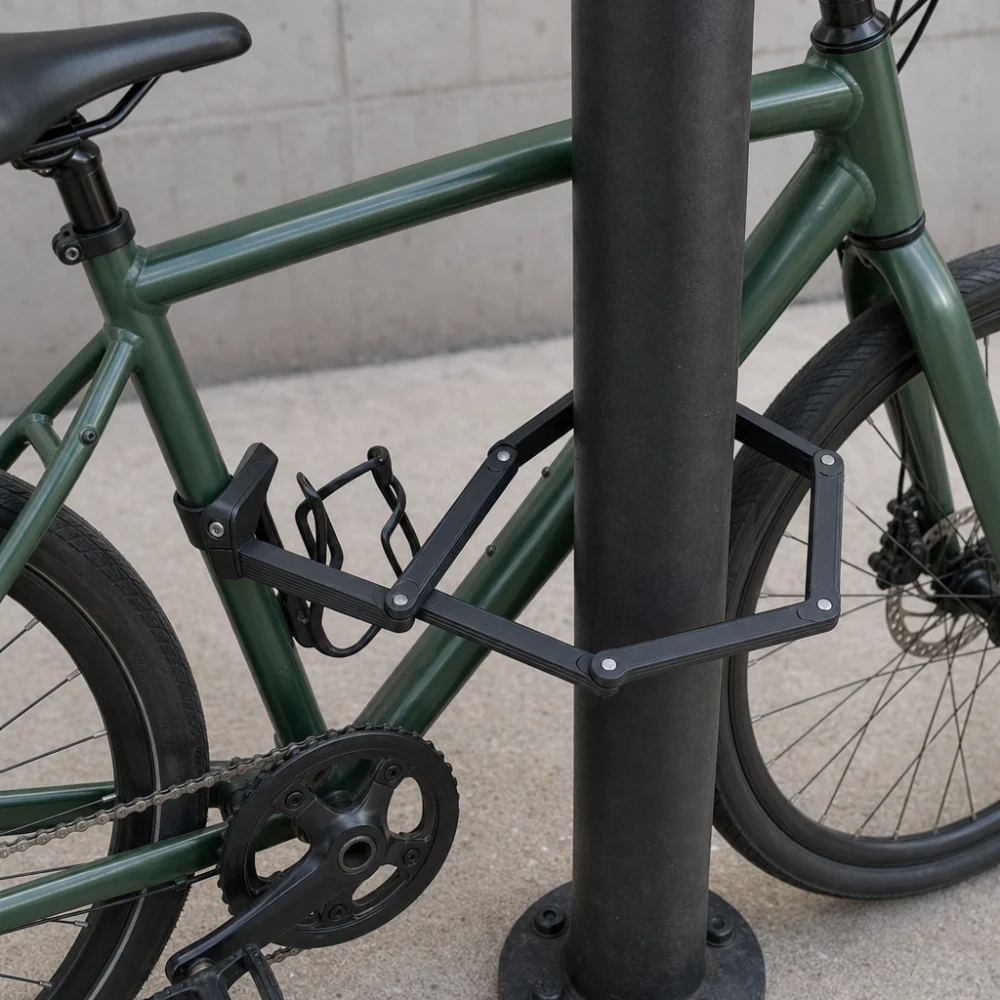
Folding bike locks use connected, hinged sections that fold together for carrying and open out when you need to secure a bicycle. Their compact folded shape can suit riders who want an alternative to carrying a bulkier lock, but the right choice depends on how you plan to carry it and what you need it to reach.
Compare the usable length, folded size, locking mechanism and carrying arrangement rather than choosing by appearance alone. No lock guarantees that a bicycle will not be stolen, so consider your parking setting and the level of risk you are prepared to accept.
What should you look for in a folding bike lock?
Start with the places you usually park and the objects you need to secure your bike to. Choose a lock with enough usable reach for those situations, then check whether its folded size and carrying method work with your routine. Longer reach may offer more flexibility, while a larger or heavier lock may be less convenient to carry. Specifications vary by model, so always check the individual product page before buying.
Compare the key buying factors
| Feature | What It Means | Why It Matters | What To Check |
|---|---|---|---|
| Usable length | How far the opened lock can extend around a bicycle and a fixed object. | It affects which parking points and bike positions are practical. | Look for the stated length and consider the objects you commonly use for parking. |
| Folded size | The space the lock takes up when stored. | A compact bundle may be easier to carry, but storage needs vary by bike and rider. | Check folded dimensions and how the lock is intended to be carried. |
| Weight | The lock’s carrying weight. | A heavier lock can be less comfortable to transport, while weight alone does not establish security. | Compare the stated weight with your carrying preference; do not use it as a stand-in for a security rating. |
| Locking mechanism | The way the lock is secured and released, such as with a key or a combination. | The mechanism affects personal preference and what you need to keep track of. | Confirm the mechanism and any included keys or instructions described on the product page. |
| Construction and security information | Details the maker provides about the lock’s sections, joints and any security assessment. | Design details and verified ratings can help you compare options for your use, but do not guarantee an outcome. | Review stated materials, construction details and any named rating only when explicitly provided. |
| Carrying arrangement | Whether the lock has a holder or another stated way to transport it. | A practical carrying option can make a lock easier to bring along regularly. | Check what is included, how it attaches and whether that arrangement suits your bike. |
Decide which details matter most
Reach for your usual parking places
Think about the bicycle and the fixed objects you typically use, then allow for the space needed to bring them together. A lock that is too short for your regular parking spots can be frustrating even if it folds neatly. Compare the stated opened length with your actual needs rather than assuming all folding locks reach the same distance.
Balance carry comfort with storage space
Consider where the folded lock will go during a ride: for example, in a bag or in a holder if one is specified. Check the lock’s folded dimensions and weight, and confirm whether a holder is included or described as an optional accessory. A smaller carrying package may be convenient, but it should still meet your reach requirements.
Understand the locking mechanism
Keyed and combination mechanisms suit different preferences. A key-based option means keeping track of its keys; a combination option means remembering or securely recording its code. Check the exact mechanism and the product information for any details about key or code management rather than assuming one type is more secure.
Read security claims in context
Look for specific, verifiable information about construction or a security rating when the product page provides it. A rating should be interpreted according to its stated scope; do not assume that every folding lock has one or that a particular design guarantees protection. Match the information available to where and how long you expect to leave the bicycle unattended.
Types and variations
Folding bike locks share a hinged, folding format, but differ in length, folded dimensions, weight, carrying arrangements and locking mechanism. Some products may use keys and others a combination; neither choice is automatically right for every rider. Compare the stated details of each option, since the category name alone does not establish its exact design or security information.
Choose for your riding and parking needs
- For frequent rides with limited carrying space: Prioritize folded dimensions and a carrying arrangement that fits your bike or bag, while checking that the opened length still suits your parking locations.
- For varied parking locations: Pay close attention to usable length and consider whether the lock can reach the fixed objects you are likely to encounter.
- For riders who prefer not to carry keys: Check whether a combination mechanism is offered and whether its code-management approach suits you.
- For higher-concern parking settings: Give verified construction details or an explicitly stated security rating more weight in your comparison, while recognizing that a lock cannot guarantee a particular result.
Common buying mistakes
- Choosing only by folded size: A compact lock may be easy to carry but may not reach your regular parking points. Check both folded dimensions and usable length.
- Assuming every lock has the same mechanism: Key and combination options differ. Confirm the mechanism before deciding what will be convenient for you.
- Treating weight as a security score: Weight alone does not establish a lock’s protective performance. Look for explicit, relevant information instead.
- Assuming a holder is included: Carrying accessories and what comes in the package can vary. Check the individual product details.
- Expecting a lock to remove all risk: No product can guarantee that a bicycle will remain secure. Consider your parking context when deciding what level of lock information and construction is appropriate for you.
Safety and suitability
Choose a lock intended for bicycle use and review its stated size, compatibility notes and instructions. A lock’s presence does not guarantee theft prevention, and suitability depends on the bicycle, parking point and circumstances. If a product page specifies limits or compatibility conditions, use those details when deciding whether it fits your needs.
Ownership, care and storage
Before buying, check how the lock is meant to be carried and whether any holder or other accessory is included. Consider whether its folded size fits your planned storage spot. Follow the maker’s care and storage guidance for the specific product; do not assume all locks have identical maintenance needs.
A simple buying process
- List the places where you commonly park and the objects you expect to secure the bike to.
- Compare the stated usable length with those parking needs.
- Narrow options by folded size, weight, carrying arrangement and preferred locking mechanism.
- Review any specific construction details or security information without treating an unstated claim as a guarantee.
- Check the individual product page for dimensions, included accessories, compatibility notes and care guidance before choosing.
Buyer checklist
- Does the stated length suit your usual parking locations?
- Can you carry and store the folded lock comfortably?
- Do you prefer a key or combination mechanism?
- Are the carrying method and included accessories clearly described?
- Have you checked any relevant construction, rating or compatibility details provided?
Frequently asked questions
Are folding bike locks easy to carry?
They fold into a smaller bundle than their opened form, but carrying convenience depends on the individual lock’s size, weight and storage arrangement. Check those details against how you plan to transport it.
How long should a folding bike lock be?
There is no single length that suits every parking situation. Consider the bicycle and the fixed objects you commonly use, then compare those needs with the stated usable length.
Should I choose a keyed or combination folding lock?
Choose the mechanism that best fits how you prefer to manage access. Check the product information to confirm the mechanism; do not assume one type is inherently more secure.
Does a heavier folding lock provide better security?
Weight by itself is not a reliable measure of security. Compare explicit construction details or a stated rating when available, and weigh those details against your carrying needs.
Does every folding bike lock come with a frame holder?
Included carrying accessories can vary. Check the product page to see whether a holder is included, optional or not specified.
Can a folding bike lock guarantee that my bicycle will not be stolen?
No lock can guarantee that outcome. Consider the place and duration of parking, and use the product’s stated security information to make a decision suited to your circumstances.