
Choosing oars starts with the boat and how its rowing positions are arranged. The right pair needs to reach comfortably from the oarlocks or sockets, while fitting the boat’s width and the space available for storage.
This guide focuses on selecting oars, not motors or other propulsion equipment. It also explains how to distinguish a complete oar from a sleeve or other accessory, and which product details to confirm before you buy.
Compare Oars


As an Amazon Associate we earn from qualifying purchases.
Which oars are right for your boat?
Start with the boat’s rowing setup: measure or consult its guidance for the suitable oar length, and check the distance between the oarlocks or sockets. Then compare the oars’ construction, whether they come as a pair, and any included collars or fittings. A split-shaft design may be easier to store, but its joint and assembled length need to suit your use. Verify the details on the individual product page rather than choosing by length alone.
Oar comparison at a glance
| Feature | What It Means | Why It Matters | What To Check |
|---|---|---|---|
| Length and rowing position | Oar reach depends on the boat’s width and where the oars sit. | A suitable fit supports a comfortable rowing position; too long or short may be awkward to use. | Boat guidance, oarlock or socket spacing, and the product’s stated length. |
| Shaft construction | Oars may use different materials or a solid or split shaft. | Construction can affect weight, handling, care, and how compactly the oars store. | Material, overall design, and any joint or connection details. |
| Blade shape and construction | The blade is the working end that moves through the water. | Blade form and construction affect how the oar feels in use and how it fits your needs. | Blade dimensions or shape when provided, and whether the product is intended for your boating setup. |
| Pair and included fittings | A listing may describe a pair, a single oar, or an accessory. | Confirming what is included prevents confusion about whether you are buying complete oars. | Quantity, included collars or stops, and whether any pictured fitting is sold separately. |
| Oarlock or socket fit | The oar must be supported by the boat’s rowing hardware. | Fitting depends on the boat’s setup and the oar’s specified interface. | Any stated compatibility or fitting dimensions; do not assume all oars fit all hardware. |
What to consider when choosing oars
Length and boat geometry
Oar length is closely tied to the boat’s width and the position of its oarlocks or sockets. If you are replacing an existing pair, use the boat maker’s guidance or the dimensions of a known suitable oar as a starting point. For a first purchase, check the boat’s recommended range and compare it with the exact length stated for the oars.
Specifications vary by model, so always check the individual product page before buying.
Material and shaft design
Material and construction can influence handling, weight, care, and storage, but a material name alone does not establish how a particular oar will perform. Compare the stated construction and any care information against how often you expect to transport or store the oars. A split shaft can be useful where compact storage matters; check how it connects and its assembled length.
Blade and handle details
Blade shape and size, along with the handle’s form, are worth checking when the product page provides those details. Consider how the oars will be held and stored, and whether the design matches the boat’s intended rowing setup. Avoid assuming that a larger-looking blade or a particular handle style is automatically better for every boat.
Fittings and what the listing includes
Check whether the listing is for a pair of complete oars, one oar, or a separate sleeve or fitting. Oar stops or collars may help position an oar relative to its support, but confirm whether they are included and whether they suit the oar and boat hardware. Product photographs may show items that are not part of the listed contents, so read the description carefully.
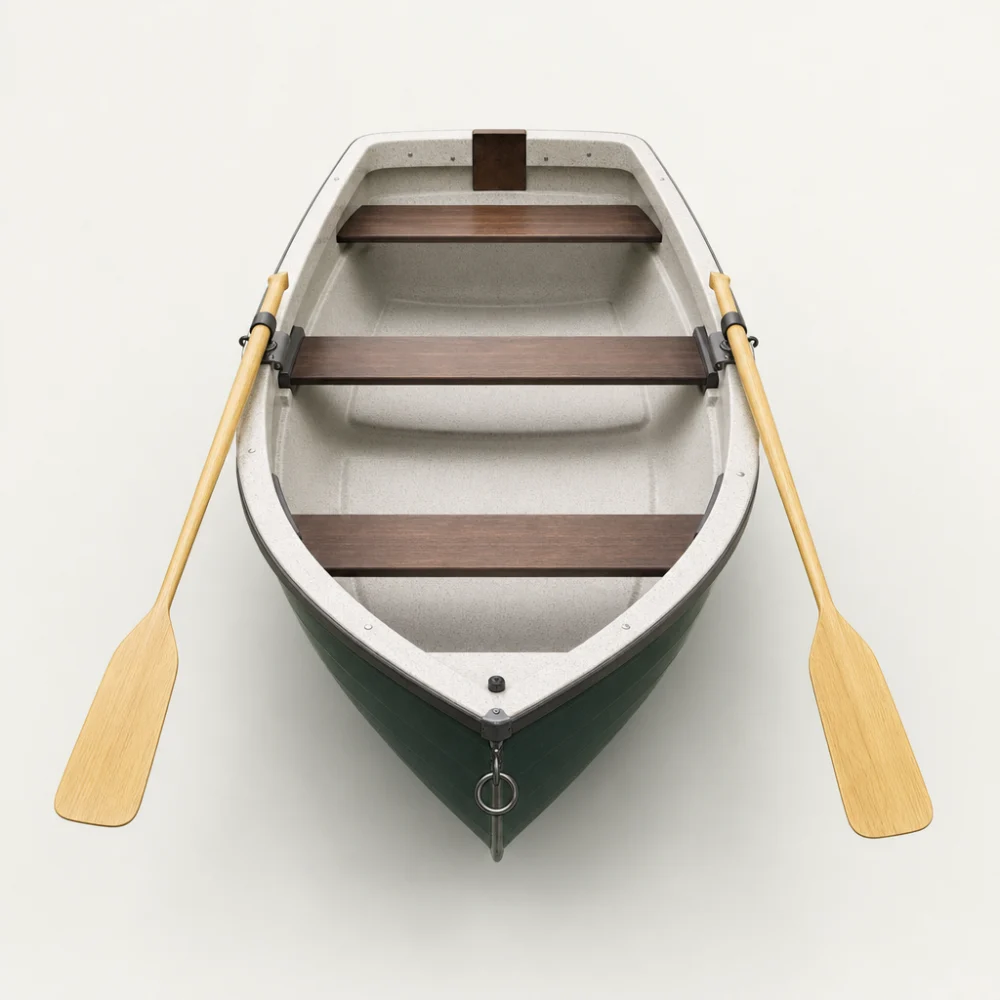
A simple fit check can keep the key measurements in view: boat width, support spacing, and oar reach all matter together.
Types and useful variations
- One-piece oars: A continuous shaft avoids a center joint and may suit buyers who have room to store and transport full-length oars. Check the overall length against both the boat and available storage.
- Split-shaft oars: These separate for more compact storage or transport. Confirm how the sections join, the assembled length, and whether the connection is designed for your intended use.
- Oars with stops or collars: These include a feature intended to help keep the oar positioned at its support. Check the stated fit and whether the fittings are included with the oars.
These descriptions do not guarantee that a particular option is available in the category. Check each listing for its actual design and included parts.
Choose for your boating needs
- Replacing a pair: Match the boat’s recommended length and support arrangement, then compare the old oars’ fit and any relevant product details. Do not rely on appearance alone.
- Limited storage or frequent transport: Consider a split-shaft design if its assembled fit suits the boat. Balance easier storage against the need to check the joint and connection details.
- Buying a first set: Start with the boat’s guidance for oar length and fitting, then check whether the listing includes a pair and any needed stops or collars.
- Replacing an accessory: Confirm whether you need a complete oar or a separate sleeve or fitting, and compare the accessory’s stated dimensions with the oar.
Common oar-buying mistakes
- Choosing by length alone: Length matters, but so do boat width and the position of the supports. Check the rowing setup as a whole.
- Assuming every oar fits every oarlock: Fit can depend on the oar and the boat hardware. Verify stated compatibility or dimensions before deciding.
- Overlooking what is included: A listing may refer to a pair, a single oar, or an accessory. Check the quantity and contents rather than inferring them from a photo.
- Ignoring storage needs: Full-length oars may be inconvenient where space is limited. Compare the stored dimensions of a one-piece design with the connection details of a split-shaft option.
- Treating a material label as a complete comparison: Material alone does not tell you everything about handling or care. Review the full construction details and product guidance.
Safety and suitability
Choose oars intended for the boat’s rowing setup and check that they fit its supports securely according to the product and boat guidance. Oars are not a substitute for the boat’s other required equipment or safe boating practices. If the boat’s fit requirements are unclear, confirm them with its manufacturer before buying.
Care and storage
Follow the care instructions supplied for the specific oars, since materials and finishes can differ. Consider whether you have a suitable place to store their full length or, for a split design, both sections and the joint. Keep included fittings together so they are available when you need the oars.
A simple buying process
- Identify the boat and how its oars are supported.
- Check the boat’s recommended oar length and relevant fit requirements.
- Decide whether one-piece or split-shaft storage better suits your needs.
- Compare construction, blade details, quantity, and included fittings.
- Confirm the exact product dimensions, contents, and compatibility information before buying.
Oars buyer checklist
- Have I checked the boat’s guidance for oar length?
- Do I know the support spacing and fitting requirements?
- Is this listing for a pair of complete oars, a single oar, or an accessory?
- Do the construction and storage format suit how I will transport and store them?
- Have I checked which collars, stops, or other fittings are included?
- Have I reviewed the individual product details for dimensions and compatibility?
Frequently asked questions
How do I choose the right oar length?
Use the boat maker’s guidance and account for the boat’s width and the location of its oarlocks or sockets. Compare that guidance with the product’s stated length. If you cannot establish the fit, ask the boat manufacturer or a knowledgeable boating retailer before choosing.
Do oars come as a pair?
Not necessarily. Check the listing for quantity and included contents rather than assuming that a product title or image indicates a pair.
What is the benefit of split-shaft oars?
They can be easier to transport or store when full-length oars are inconvenient. The trade-off is an additional connection to consider, so check the joint design and assembled dimensions.
Are oars and oar sleeves the same thing?
No. Oars are the complete rowing equipment; a sleeve is an accessory associated with an oar. If you need complete oars, confirm that the listing includes them rather than only a sleeve or fitting.
Will any oar fit my boat’s oarlocks?
No universal fit should be assumed. Check the oar and boat hardware specifications, including any stated dimensions or compatibility guidance, before buying.
Ready to choose?
See all 7 Oars →As an Amazon Associate we earn from qualifying purchases.