

A cast net is a fishing net selected to match the bait or other intended catch, the conditions where it will be used, and the person who will handle it. The right choice is not simply the largest net or the one with the smallest mesh opening.
Compare how each listing describes net size and mesh, then consider handling, storage, and any local restrictions. This guide focuses on choosing a suitable type rather than on how to cast or operate one.
What should you look for in a cast net?
Start with the bait or catch you intend to target and check what mesh opening is appropriate for it. Next, compare net size using the measurement convention stated in the listing, since a radius and a diameter describe different spans. Balance coverage against the effort and space needed to handle and store the net, and confirm that its intended use fits your fishing location.
Specifications vary by model, so always check the individual product page before buying.
Cast net features compared
| Feature | What It Means | Why It Matters | What To Check |
|---|---|---|---|
| Net size | The stated radius, diameter, or other size measure for the net | Affects the area covered and how manageable the net may be | Confirm the measurement and units; do not compare a radius directly with a diameter |
| Mesh opening | The space between strands in the netting | Needs to suit the intended bait size; an opening that is too large may not retain the target | Look for the stated opening size and how it is measured |
| Net construction | Materials and construction details listed for the net | Can affect feel, handling, care, and suitability for your intended use | Review the listed materials and any care guidance rather than assuming all nets are alike |
| Perimeter weighting | Details about the weighted edge, when provided | It is part of the net’s design and may affect handling and the product’s overall weight | Check the specific listing for construction details; do not infer a specification from a product title |
| Handline and storage | Information about the line and how the net is supplied or stored | Useful for assessing whether the item suits your handling and storage needs | Check what is included and whether the listed dimensions suit your available space |
Choosing the details that matter
Net size and measurement
A stated net size can refer to the distance from the center to the edge or from one edge across to the other. Those are not interchangeable measurements. Check the wording, units, and any diagram on the individual product page before comparing sizes. A larger net may cover more area, but it can also be more demanding to handle and take up more storage space.
An unlabelled visual comparison can help make radius and diameter easier to distinguish.
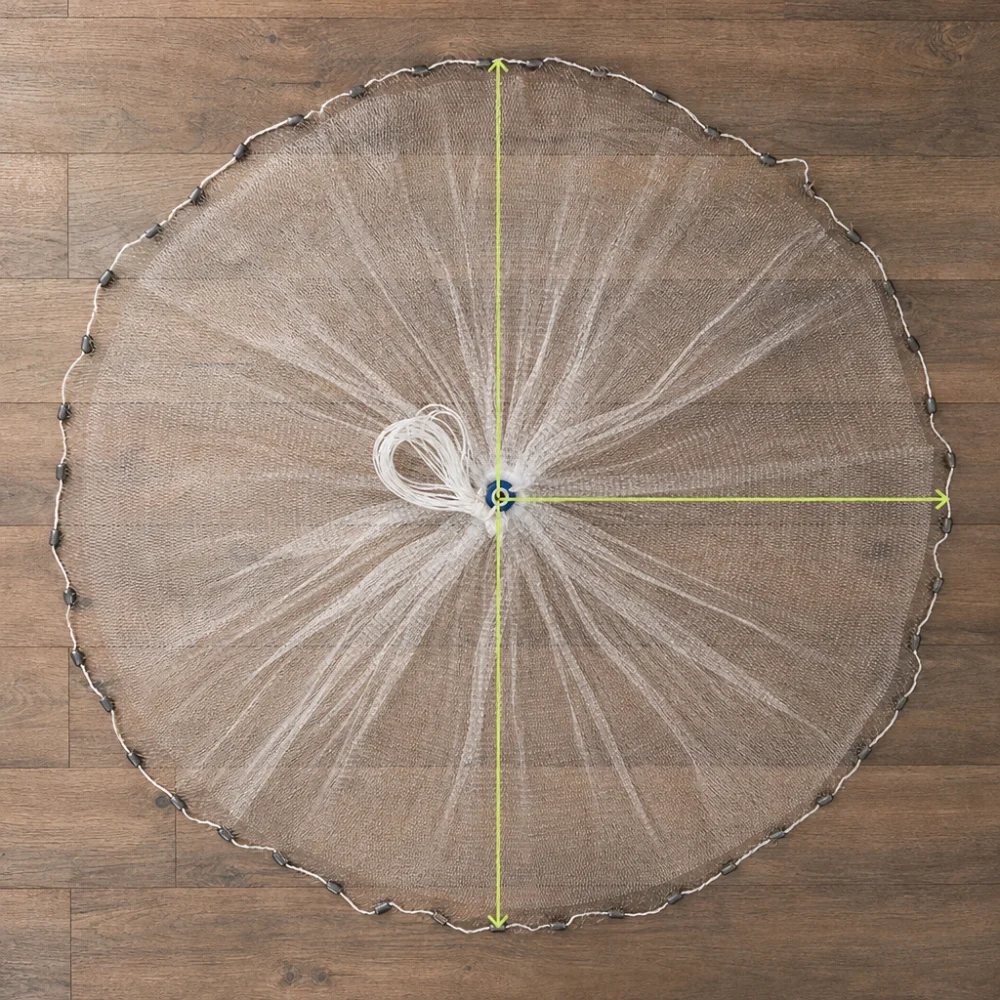
Mesh opening and target
Choose mesh with the intended bait or catch in mind. Smaller openings may be necessary for smaller bait, while an opening that is too small for your needs may be an unsuitable match. Product pages may describe mesh size in different ways, so verify the stated opening and its measurement rather than relying on a bare number.
Construction and handling
Materials, perimeter construction, and the included handline can vary. These details may matter for how a net feels to handle and how it should be cared for, but a listing does not establish suitability for every fishing condition. Consider who will use it and whether the net’s stated size and overall handling demands seem manageable for that person.
Cast net types and variations
Cast nets are commonly compared by overall size and mesh opening rather than by a single universal type label. A net with a smaller mesh opening may suit smaller target bait, while a larger opening may be a better match for larger targets; the intended catch and local requirements should guide that choice. Nets also differ in their stated dimensions and construction, so compare the actual product details instead of assuming two listings with similar names are equivalent.
Matching a cast net to your needs
- For smaller target bait: Focus on the stated mesh opening and check that it is suitable for the intended bait. Do not assume a listing’s mesh-size number uses the same convention as another listing.
- For broader coverage: Compare the stated net size, but weigh that against handling demands and storage space rather than choosing by size alone.
- For a first cast net: Favor clear product information about dimensions, mesh, construction, and what is included. A manageable size may be more practical than a larger net that is difficult for the intended user to handle.
- For replacing or upgrading a net: Compare the old net’s measurement convention and mesh opening with the new listing. Similar names or stated sizes do not necessarily mean the dimensions are directly comparable.
Common cast net buying mistakes
- Comparing unlike size measurements: A radius is half the span described by a diameter. Check what each listing measures before deciding that one net is larger.
- Choosing mesh by number alone: Mesh descriptions may use different measurement conventions. Confirm what the listed measurement refers to and whether it suits your target bait.
- Assuming the biggest net is best: More coverage may come with greater handling and storage demands. Choose a size that fits both the intended use and the person who will handle it.
- Assuming similar titles mean equivalent nets: Listings can differ in dimensions, construction, and included components. Compare details on each individual product page.
- Overlooking where the net will be used: Rules and permitted uses can vary by location. Check the requirements that apply to your intended fishing area before buying.
Safety and suitability
Choose a net that the intended user can handle and that is suited to the planned fishing conditions. A cast net includes netting and a weighted perimeter, so consider its overall handling and storage needs. Fishing rules may differ by location, species, and equipment; verify applicable requirements with the relevant local authorities before purchase and use.
Care and storage considerations
Check the product’s care guidance, since material and construction can affect appropriate cleaning and storage. Plan for enough space to store the net without forcing it into a container that may damage or tangle the netting. If a listing does not explain care or included storage items, do not assume those details are the same across models.
A simple cast net buying process
- Identify the bait or catch you intend to target and where you plan to fish.
- Check local requirements relevant to that intended use.
- Decide what mesh opening is appropriate and verify how listings measure it.
- Compare net size using the same measurement convention.
- Review construction, handling details, included components, and storage needs.
- Read the individual product information and confirm the details that matter before choosing.
Cast net buyer checklist
- Does the listed mesh opening suit the intended bait or catch?
- Is the net size given as a radius, diameter, or another clearly explained measure?
- Have you considered handling effort as well as coverage?
- Are the net’s construction and included components described clearly enough for your needs?
- Does the net suit your available storage space and care preferences?
- Have you checked requirements for the intended fishing location?
Cast net FAQs
How do I choose a mesh opening?
Use the intended bait or catch as your starting point, then confirm the opening size and its measurement convention in the product details. A mesh opening that is too large may not retain the target you have in mind.
What is the difference between a cast net’s radius and diameter?
Radius describes the distance from the center to the edge, while diameter describes the span from one edge across to the other. Check which measurement a listing uses before comparing net sizes.
Should I choose the largest cast net I can find?
Not necessarily. A larger net may offer more coverage, but handling and storage demands matter too. Consider the intended user and fishing conditions alongside the stated size.
Are cast net mesh measurements always stated the same way?
No. Check what a listing’s mesh measurement refers to instead of comparing numbers alone. If the measurement convention is unclear, the product details may not give you enough information to compare it confidently.
What should I compare when replacing a cast net?
Compare the old and new nets’ size measurements, mesh openings, construction, and included components. Make sure the size measurements use the same convention before treating them as equivalent.
Do local rules affect which cast net I should buy?
Requirements can vary with location and intended fishing use. Check the rules that apply to your planned fishing area before selecting a net.