

A chain lock secures a bicycle with linked chain and a locking mechanism. It can be a useful choice when you want a flexible lock that can wrap around different objects, but the chain’s reach and weight both affect how practical it is to carry and use.
Choose by considering where you expect to lock your bike, what you need the chain to reach, and how much weight you are willing to carry. Check each product’s details carefully: the word “chain” alone does not tell you its length, link dimensions, locking style, or level of security.
Compare Chain Locks


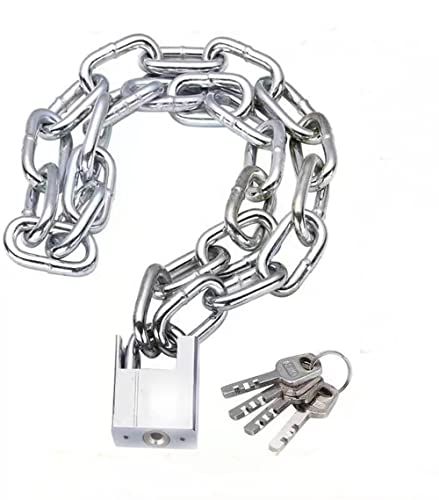
As an Amazon Associate we earn from qualifying purchases.
What should you look for in a chain lock?
Start with the length needed to pass around your bicycle and a suitable fixed object, then compare the lock’s weight and locking mechanism. Longer or more substantial chains may be less convenient to carry, while a compact, lighter choice may not reach every object or offer the characteristics you want. Confirm the stated measurements and construction on the individual product page before deciding.
Chain lock buying factors compared
| Feature | What It Means | Why It Matters | What To Check |
|---|---|---|---|
| Chain length | The stated length of the chain. | Determines what the chain may be able to reach and how much flexibility it offers. | Check the listed measurement and consider the objects and bicycle parts you need to secure together. |
| Link construction | The shape and stated dimensions of the chain links. | Link size can affect how the chain fits around objects and may contribute to its bulk and weight. | Look for link dimensions and construction details where provided; do not infer security from appearance alone. |
| Locking mechanism | The mechanism that secures and releases the chain, such as a key or combination style. | Different styles involve different preferences for access and key or code management. | Confirm the mechanism, what is included, and any instructions for use. |
| Weight and bulk | How much the lock weighs and how it can be carried. | A heavier or bulkier lock may be less convenient on regular rides. | Check listed weight and dimensions, and consider how you will carry or store it. |
| Protective covering | A sleeve or covering around some chains. | A covering may help keep the chain separated from the bicycle’s finish during contact. | Check whether a covering is included and how much of the chain it covers. |
| Stated security information | Any security rating or performance claim made for the particular lock. | Claims can differ by product and should not be assumed from a category name or appearance. | Check who issued any rating and what the product information says it represents. |
How to choose the right chain lock
Match length to the places you use
Think about the objects you typically want to secure your bicycle to, and whether you need to pass the chain around more than one part of the bike. A shorter chain can be easier to handle and carry, but may not reach the objects in your usual locations. A longer chain can offer more routing flexibility, with additional bulk to account for. Compare stated length rather than relying on product photos.
Balance link dimensions with carrying comfort
Link dimensions and chain construction are useful comparison details, but they do not establish a particular level of protection by themselves. A chain that feels substantial may also be heavier to transport. Compare any stated link measurements and lock weight, then weigh those details against your carrying preferences and intended use.
Choose a locking style you can manage
Keyed and combination mechanisms suit different routines. A keyed mechanism means keeping track of the key; a combination mechanism means remembering the code and following the product’s instructions for setting or changing it, if applicable. Confirm the exact mechanism and any included keys or other components instead of assuming them from the product title.
Check the covering and overall dimensions
A protective sleeve may be useful if you want a layer between the chain and your bicycle’s finish. Check whether a sleeve is included and whether it covers the chain as you expect. The overall dimensions also matter for carrying and storage, particularly if you plan to keep the lock in a bag or bicycle storage area.
Specifications vary by model, so always check the individual product page before buying.
Chain lock types and variations
Chain locks can differ in their locking mechanism, chain dimensions, length, weight, and whether the chain has a protective covering. A keyed style may suit someone who prefers physical keys, while a combination style may suit someone who would rather manage a code; each involves its own access routine. These distinctions do not establish how resistant a particular lock is, so check any product-specific security information separately.
Which chain lock may suit your needs?
- For regular commuting: Compare weight and carrying dimensions closely, alongside the length needed for your usual stops. A lock that is inconvenient to carry may not suit a routine that involves taking it along every day.
- For varied locking locations: Prioritize a length that can accommodate the objects you are likely to encounter. More reach can add carrying bulk, so consider the trade-off rather than choosing by length alone.
- For occasional use: Consider where the lock will be stored and whether its weight and dimensions are practical for those trips. A longer or heavier chain may be less of a concern if you do not carry it often, but it still needs to fit your intended use.
- For simpler access preferences: Decide whether a key or combination mechanism better fits how you keep track of keys or codes. Confirm the exact locking style and included components on the product page.
Common chain lock buying mistakes
- Choosing by length without considering weight: A longer chain may be more flexible but can be less convenient to carry. Compare both measurements before settling on a size.
- Assuming a thick-looking chain guarantees protection: Appearance alone is not a security rating. Look for product-specific security information and understand what it says before relying on it.
- Overlooking the locking mechanism: A key or combination style affects how you access the lock. Check which one the product uses and what is included.
- Assuming every chain has a sleeve: Coverings vary. Confirm whether a protective sleeve is included and how it is described.
- Buying without considering the locking location: A chain that is too short may not reach the objects you intend to use. Think through the space and routing you need, then compare the stated length.
Safety and suitability
Choose a lock for your intended bicycle and use, and follow the product’s information about its limitations. No lock should be treated as a guarantee against theft. If security information is important to your decision, assess the specific product claims rather than assuming that all chain locks offer the same protection.
Ownership, maintenance, and storage
Consider where the lock will live between rides and how you will carry it without interfering with your bicycle or other belongings. Keep any keys or combination information accessible to you, and follow the manufacturer’s care and storage guidance. If a chain or locking mechanism needs attention, use the product’s instructions rather than assuming that the same care applies to every model.
A practical buying process
- Identify where and how you expect to secure your bicycle.
- Estimate the chain length needed for those locations and the parts you intend to secure.
- Compare stated chain dimensions, weight, overall size, and any protective covering.
- Choose a keyed or combination mechanism that fits your access preferences.
- Review product-specific security information and confirm the listed measurements and included components.
Chain lock buyer checklist
- Does the stated chain length suit the objects and bicycle parts you intend to secure?
- Have you checked the chain dimensions, overall size, and listed weight?
- Do you prefer the product’s stated locking mechanism?
- Is a protective sleeve included, if you want one?
- Have you checked any security claims and what they specifically represent?
- Will the lock be practical to carry and store for your routine?
Frequently asked questions
How long should a chain lock be?
Choose a length that can reach the objects and bicycle parts you intend to secure together. The space available at your usual stops can vary, so compare the listed measurement with your likely needs instead of relying on a general rule.
Are thicker chain links always more secure?
Not necessarily. Link dimensions alone do not verify a lock’s security or performance. Check any product-specific security information and consider the lock’s other stated characteristics.
Should I choose a keyed or combination chain lock?
That depends on which access routine you prefer. A keyed option involves keeping track of a key, while a combination option involves managing a code. Confirm the mechanism and included components for the particular product.
Do chain locks come with protective sleeves?
Some may have a protective covering, but it should not be assumed for every lock. Check the product details to see whether a sleeve is included and how it covers the chain.
Can I judge a chain lock’s security from its appearance?
No. A substantial appearance does not establish a security rating or guarantee protection. Review the specific product information and any stated security claims when comparing options.
What should I check before buying a chain lock online?
Verify the chain length, dimensions, weight, locking mechanism, and any included covering or components. Also review product-specific security information and consider whether the lock will be manageable to carry and store.
More Chain Locks
See all 53 Chain Locks →


As an Amazon Associate we earn from qualifying purchases.