
Hammock stands are useful when you want to use a hammock without relying on trees, posts, or permanent anchor points. They can make a hammock work in a backyard, on a patio, at a campsite with limited hanging options, or in other places where a traditional setup is not convenient.
The main buying decision is usually less about style and more about fit: will the stand suit the hammock you already have, the space you have available, and the way you plan to use it? That means looking closely at overall size, support style, portability, and how much setup you are comfortable with.
Because hammock stands vary widely, it helps to compare them by practical use rather than by appearance alone. Specifications vary by model, so always check the individual product page before buying.
What should I look for in a hammock stand?
The best starting point is whether the stand matches your hammock and your space. A good stand should hold the hammock in a comfortable position without feeling cramped, oversized, or awkward for the area where you plan to use it. The next most important question is whether you need something that stays put in one place or something you can move and store more easily.
After that, compare the details that affect convenience: the stand’s footprint, how much assembly it seems to require, and whether it appears suited to indoor, outdoor, or mixed use. The right choice is often the one that fits your actual routine rather than the one with the most features.
| Feature | What It Means | Why It Matters | What to Check |
|---|---|---|---|
| Hammock fit | How the stand is intended to work with a hammock of a certain length or style | Poor fit can make the hammock hang too tightly or too loosely | Check the product page for compatibility details and any hammock type guidance |
| Footprint | The amount of floor or ground space the stand takes up | Important for patios, decks, rooms, and smaller campsites | Compare overall dimensions and allow room for use around the stand |
| Portability | How easy the stand is to move, pack, or store | Matters if you want seasonal use or plan to relocate it often | Look for weight, foldability, and setup approach if those details are provided |
| Stability approach | The design features that help the stand feel steady in use | Affects confidence and comfort, especially on uneven or active surfaces | Review the base style, support layout, and any notes about recommended surfaces |
| Assembly | How the stand goes together and how often you may need to set it up | Some buyers want a leave-in-place setup; others want something simpler to manage | Check whether the listing describes tool needs, parts count, or storage convenience |
Key decision criteria
Size and hammock compatibility
This is the most important check for most buyers. A stand that looks suitable in photos may still be a poor match if it is designed for a different hammock length or style than the one you use. If you already own a hammock, compare the product page details carefully before assuming it will work.
Placement and available space
Think about where the stand will live most of the time. Backyard setups, porch use, and indoor spaces all create different space limits, and a stand that seems manageable in an open area may feel bulky in a narrow one. Measure the intended spot and leave room for getting in and out of the hammock comfortably.
Portability versus permanence
Some shoppers want a stand they can keep in one place for easy daily use. Others need something they can move between locations or store away when not in use. Portable setups are usually more flexible, while more permanent-feeling options may be better for steady use in one spot.
Setup effort
If you expect to move the stand often, assembly and disassembly matter more. If it will mostly stay assembled, convenience may matter less than overall stability and fit. It is worth checking whether the product information suggests simple setup or a more involved process.
Material and finish considerations
Buyers often focus on appearance, but finish also affects where and how the stand will be used. Indoor use, outdoor exposure, and long-term storage can all change what feels practical. Look for product-page guidance about intended use and care, especially if the stand may spend time outside.
Common hammock stand types and variants
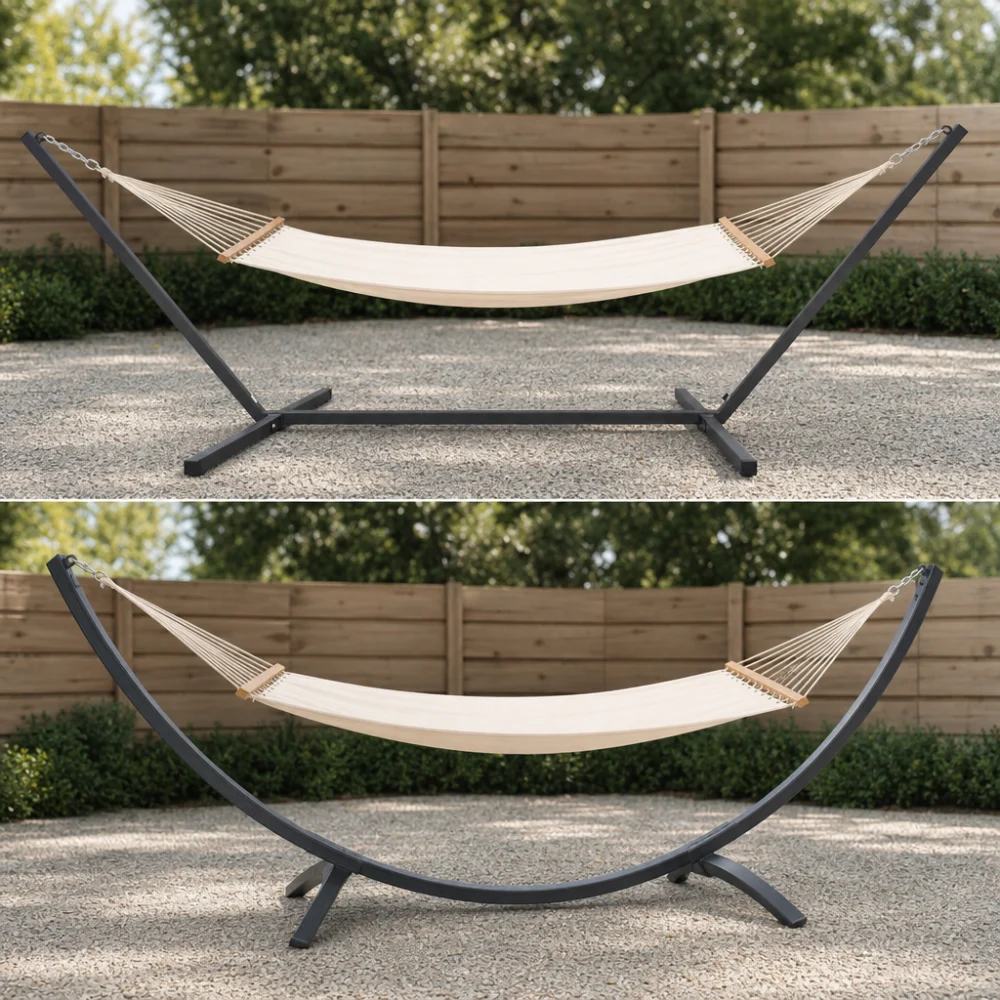
Hammock stands usually differ by how they balance size, portability, and stability. Some are built for stationary use in a yard or patio setting, while others are designed to fold or break down for easier moving and storage. There are also stands that emphasize a compact footprint for smaller spaces.
The right type depends on how often you plan to relocate the stand and how much room you have to work with. If you want a simple, dedicated spot for lounging, a more substantial stand may make sense. If you need flexibility, a lighter or more compact option may be easier to live with.
Which stand suits which buyer?
| Buyer need | What to prioritize | Why it matters |
|---|---|---|
| Backyard or patio lounging | Steady placement, fit, and comfort | You may care more about everyday convenience than packing size |
| Camping or travel use | Portability and easier setup | Moving and storing the stand becomes part of the buying decision |
| Smaller living spaces | Footprint and storage needs | A bulky stand can be harder to place or put away |
| Occasional seasonal use | Simple assembly and storage convenience | You may not want a stand that is cumbersome to handle between uses |
| Gift buyers | Compatibility clarity and straightforward setup | Clear product-page details help reduce the risk of choosing the wrong style |
Common mistakes to avoid
- Assuming any hammock will fit any stand. Fit is one of the most important checks, so review the product details instead of relying on general appearance.
- Ignoring the footprint. A stand can work well in photos and still feel oversized in the space you actually have.
- Focusing only on portability. Easy moving is useful, but not if the stand becomes less convenient for your main use case.
- Overlooking storage. If the stand will be put away between uses, storage convenience matters almost as much as setup.
- Expecting all stands to feel the same in use. Design differences affect stability, convenience, and comfort, even within the same category.
Safety and suitability caveats
Check that the stand is intended for the hammock style you plan to use and that it suits the surface or location where you want to place it. Uneven ground, cramped spaces, and mismatched components can all make a setup less practical. If the product page gives guidance about intended use, follow that closely when deciding whether it fits your needs.
Specifications vary by model, so always check the individual product page before buying.
Maintenance, storage, and ownership considerations
Think about how often you will take the stand apart, move it, or store it. A stand that will live outdoors may need different care than one used only occasionally or kept indoors between uses. If you plan to store it for long periods, it is worth considering whether the design looks manageable to clean, dry, and put away.
It also helps to think ahead about accessories you may already own or plan to buy, since a stand is only one part of the full hammock setup. A careful comparison now can prevent frustration later if the stand and hammock do not work together as comfortably as expected.
How to compare hammock stands efficiently
- Decide where you will use it most often.
- Check that the stand is suitable for your hammock type and size.
- Compare footprint, portability, and setup effort.
- Look at any notes about stability, materials, or intended use.
- Read the individual product page before making a final choice.
Summary buyer decision checklist
- Does the stand match the hammock style you plan to use?
- Will it fit the space where you want to place it?
- Is portability important, or will it stay in one location?
- Does the setup effort seem reasonable for how often you will use it?
- Have you checked the product page for any model-specific guidance?
- Will storage and care be manageable for your routine?
Frequently asked questions
Do I need a hammock stand if I have trees nearby?
Not necessarily, but a stand can make use more flexible and predictable. It is helpful when tree spacing is awkward, when you want to move the setup, or when you prefer not to rely on fixed anchor points. The main benefit is convenience, not replacing every possible hanging method.
Are all hammock stands meant for the same kind of hammock?
No. Different stands may be suited to different hammock lengths or styles, so compatibility should be checked carefully. If you already own a hammock, compare the product page details before assuming a stand will work with it.
Is a larger stand always better?
Not always. A larger stand may offer more space, but it can also take up more room and be harder to move or store. The better choice is the one that fits your hammock and your space without adding unnecessary bulk.
What matters more: portability or stability?
That depends on how you plan to use the stand. If you will move it often, portability may matter more; if it will stay in one place, stability and convenience may matter more. Most buyers need to balance both rather than maximizing only one.
Can I use a hammock stand indoors?
Some buyers do use stands indoors, but room size, floor space, and the stand’s footprint all become important. Check whether the stand seems practical for the room you have and whether it can be positioned comfortably with enough clearance around it.
What should I check before buying a stand as a gift?
Focus on fit, footprint, and ease of setup. A gift is more likely to be useful if the recipient’s hammock style and available space are reasonably clear. When in doubt, choose a stand only if the product information gives enough compatibility guidance to make the match sensible.