
Hammock bug nets are for campers who want insect protection without giving up the open feel of a hammock. They can be a simple add-on or a built-in part of a hammock system, so the right choice depends on how you camp and how much convenience you want.
If you are comparing options for the first time, the main question is not just whether a net blocks bugs. It is whether the net works smoothly with your hammock, suspension, and preferred setup style. A good match is usually easier to live with than a feature-heavy net that is awkward to use.
Because hammock setups vary, it helps to focus on fit, coverage, entry style, ventilation, and how the net attaches. Specifications vary by model, so always check the individual product page before buying.
What should you look for in a hammock bug net?
The best starting point is compatibility with your hammock shape and suspension. After that, compare how the net opens, how fully it encloses the hammock, and whether it seems easy to set up at your campsite. The main trade-off is usually between simplicity and convenience: a more integrated system can feel cleaner to use, while a separate net can be more flexible.
| Feature | What It Means | Why It Matters | What To Check |
|---|---|---|---|
| Fit and compatibility | How well the net matches your hammock style and suspension setup | A poor fit can leave gaps, sagging, or unnecessary hassle | Hammock shape, attachment method, and whether the net is meant for your setup style |
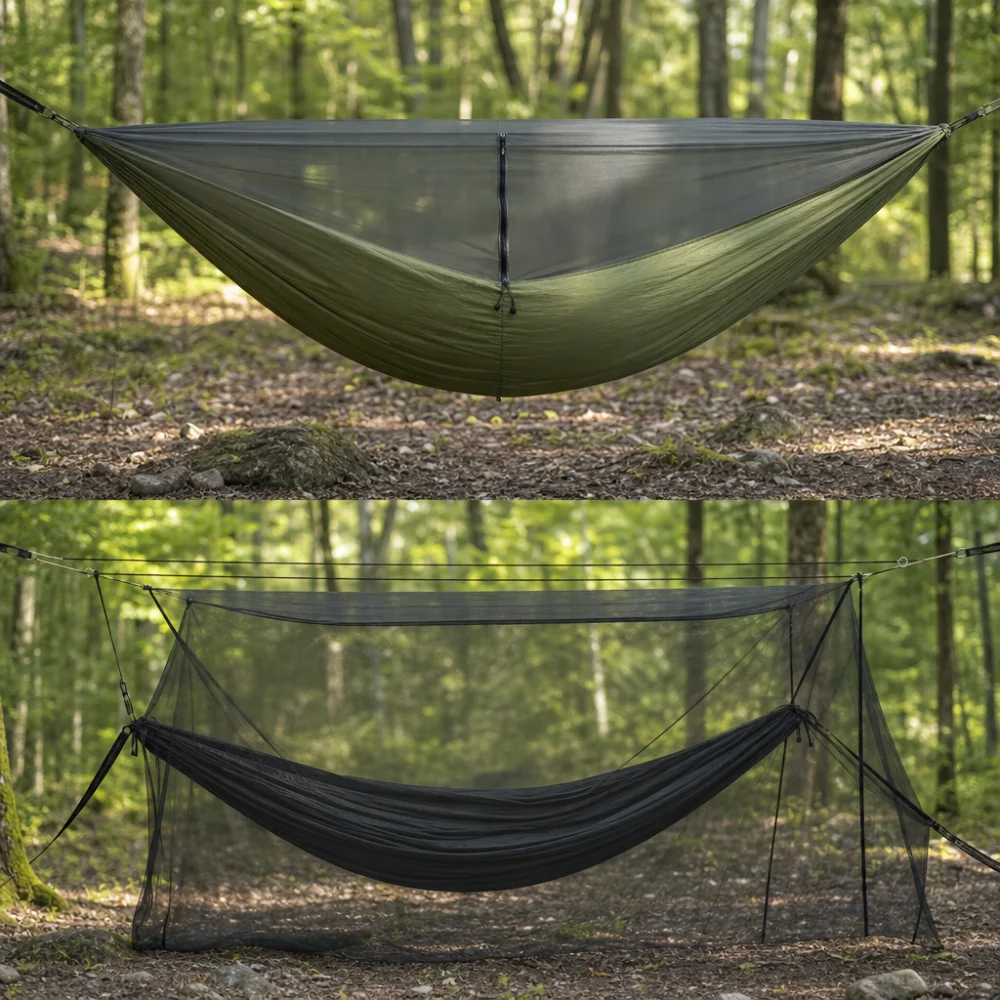
| Coverage | How completely the net surrounds the sleeping area | Coverage affects insect protection and comfort around entry points | End closures, side coverage, and any areas that may be left exposed |
| Entry style | How you get in and out of the netted hammock | This affects convenience at night and how easy it is to use with layers or gear | Zipper placement, opening size, and whether access feels natural |
| Attachment style | How the net connects to the hammock or suspension | Attachment style affects setup speed, tension, and how stable the net feels | Whether it clips, zips, loops, or uses a separate support arrangement |
| Ventilation and space | How airy and roomy the enclosed area feels | Better airflow can improve comfort in warmer conditions | Net shape, interior volume, and whether the design feels close or spacious |
| Packability | How easily the net fits into your camping kit | Smaller packed size can matter on trips where every item counts | Whether the net seems easy to store and carry with the rest of your hammock system |
Key decision criteria explained
Compatibility comes first
Many buying problems come from assuming one bug net works with every hammock. Some nets are designed for a specific shape or way of hanging, while others are more adaptable. Check how the net is intended to attach and whether it is made for your style of hammock before thinking about anything else.
Choose coverage based on your campsite conditions
If insects are persistent where you camp, full enclosure matters more than a minimal design. If you mostly want a light layer of protection in milder conditions, a simpler net may be enough. Think about how much coverage you want around the head, shoulders, and edges, not just whether the net has a zipper.
Think about access and everyday use
Some nets feel easy to live with because they open and close naturally when you are tired, carrying gear, or moving around in the dark. Others may be fine once set up but less pleasant when you use them often. The more frequently you plan to enter and exit the hammock, the more important the access design becomes.
Balance airflow with protection
A bug net should help with insects without making the hammock feel overly enclosed. A tighter or more complete design may offer stronger coverage, while a roomier one may feel more breathable. The right balance depends on whether your priority is maximum bug protection or a lighter, less confined feel.
Common hammock bug net types
Hammock bug nets usually fall into a few practical styles. A separate net can work well if you want flexibility across different hammock setups. An integrated net may feel simpler because fewer pieces need to be managed, but it can be less adaptable if you change your hammock system often.
Some designs focus on minimal weight and simple coverage, while others emphasize easier entry or a more enclosed sleeping area. The useful question is not which style sounds more advanced, but which one matches the way you actually camp.
Which type suits which buyer?
| Buyer need | Helpful features | Why it suits that use |
|---|---|---|
| First-time hammock camper | Simple attachment, clear setup, straightforward access | Reduces confusion and makes the learning curve easier |
| Frequent weekend camper | Easy entry, dependable coverage, comfortable interior space | Daily convenience matters more when you set up often |
| Traveler trying to pack light | Compact storage and a design that stays organized with the hammock | Helps keep the overall kit simpler to carry |
| Buyer focused on insect-heavy campsites | Fuller coverage and careful attention to closure points | More complete enclosure can be more reassuring in buggy conditions |
| Buyer with multiple hammock setups | Flexible compatibility and easy attachment | Makes the net more useful across different gear combinations |
Common mistakes and misunderstandings
- Choosing based only on the idea of “bug protection” instead of checking the actual attachment style and hammock fit.
- Assuming a roomier hammock automatically needs the same kind of net as a compact one.
- Overlooking how you will enter and exit the hammock once the net is in place.
- Focusing on packed size alone and forgetting that ease of use affects the camping experience too.
- Ignoring whether the net seems likely to work with the rest of the hammock setup you already use.
Safety and suitability caveats
A bug net is a comfort and insect-control accessory, not a universal solution for every camping condition. Make sure the design suits your hammock, your campsite, and the kind of insect pressure you expect. If you need extra protection from weather, that is a separate buying question from bug coverage.
Also check how the net is intended to be used with the rest of your hammock system. A net that sounds appealing in isolation may be less practical if it makes your setup awkward or does not match your suspension style.
Maintenance, storage, and lifespan considerations
General care is usually straightforward, but it still matters. Look for a net that seems easy to keep clean, dry, and stored without unnecessary tangles or stress on the attachment points. If a design depends on zippers, cords, clips, or separate pieces, consider whether those parts look easy to manage over time.
For hammock accessories in general, the easiest-to-own option is often the one that stores neatly with the rest of your kit and does not require much fuss after each trip.
How to compare options efficiently
- Start with your hammock style and how you expect the net to attach.
- Decide whether you want a simple add-on or a more integrated setup.
- Compare coverage, access, and ventilation rather than focusing on one feature only.
- Think through your usual camping conditions, including insect pressure and how often you will use the hammock.
- Check the individual product page for compatibility details before deciding.
Summary buyer decision checklist
- Does the net match your hammock shape and suspension approach?
- Does the attachment method look simple enough for your setup style?
- Is the coverage level appropriate for the places you camp?
- Will the entry and exit design feel convenient in real use?
- Does the net seem easy to pack, store, and manage with your other gear?
- Have you checked the individual product page for model-specific details?
Frequently asked questions
Do hammock bug nets fit every hammock?
No, not necessarily. Fit depends on hammock shape, length, and how the net is meant to attach. It is best to confirm compatibility on the individual product page rather than assuming one net works for all hammocks.
Should I choose a separate bug net or an integrated one?
It depends on how you camp. A separate net can offer more flexibility, while an integrated design may feel simpler and more streamlined. The better choice is the one that fits your setup and how often you plan to use it.
What matters more: coverage or ventilation?
Both matter, but their importance depends on your conditions. In buggy areas, fuller coverage usually becomes the priority. In warmer weather, good airflow may matter more for comfort as long as the coverage still feels adequate.
Are bug nets mainly for long trips?
No. They can be useful on short weekend trips too, especially if insects are common where you camp. The right choice is based more on campsite conditions and comfort preferences than on trip length alone.
How do I compare bug nets quickly?
Start with fit, then look at coverage, entry style, and how the net attaches. Those four checks usually tell you more than product names or broad descriptions. After that, confirm the individual product details before buying.
What is the biggest buying mistake?
Buying a net without checking whether it works with your hammock setup. A good-looking design is not very helpful if it is awkward to attach or does not cover the sleeping area the way you need.