
Fish finders help anglers and boaters see what is below the waterline, but the right choice depends on how you fish and where you mount the unit. A simple depth-and-sonar display may be enough for some boats, while other setups call for more screen space, better readability, or additional mapping and sonar options.
This guide focuses on the buying decisions that matter before you compare individual products. It can help you sort out the features that are genuinely useful from the ones that only sound impressive on a product page.
Because fish finders are often part of a larger marine electronics setup, it also helps to think about installation, power, and whether the display is easy to read in the conditions you actually fish in.
What should you look for in a fish finder?
The best starting point is to match the unit to your boat, your fishing style, and how much detail you really need on screen. A larger display and more sonar options can make information easier to read, but they can also add cost and complexity. If you mostly want depth awareness and basic bottom information, a simpler setup may be the more practical choice.
Specifications vary by model, so always check the individual product page before buying.
| Feature | What It Means | Why It Matters | What To Check |
|---|---|---|---|
| Display size and readability | The screen area and how easy the display is to see | Clear reading matters when you are moving, in sunlight, or sharing the screen | Screen size, brightness-related details, and whether the layout is easy to read at a glance |
| Sonar capability | The way the unit looks below the boat | Different sonar styles can affect how much detail you get and how you interpret structure or depth | Which sonar functions are included and whether they match the fishing style you use |
| Transducer compatibility | The sensor that sends and receives the underwater signal | The display is only part of the system; the transducer determines what data the unit can gather | What transducer is included, what is supported, and how it mounts on your boat |
| Mounting style | How the display is installed on the boat | Mounting affects visibility, protection, and how much space the unit takes up at the helm | Whether the mount fits your available space and viewing angle |
| Power and wiring needs | How the unit connects to boat power | Some setups are easier to add than others, especially on smaller boats | Power requirements, cable routing, and whether your existing electrical setup is suitable |
Key decision criteria explained
Screen size and visibility
Screen size is not just about convenience; it affects how quickly you can read depth, sonar returns, or navigation information. A compact display may suit a small boat or tight helm space, while a larger screen can be easier to use when conditions are bright or when you want more data visible at once. The trade-off is usually space and cost versus comfort and readability.
Sonar features
Fish finders vary in how they present underwater information. Some buyers want a straightforward depth display, while others want more detail about bottom contour, structure, or fish marks. The important question is not how many sonar terms appear in a listing, but whether the features support the kind of water you fish and the detail level you actually need.
Transducer choice
The transducer is one of the most important parts of the system because it affects what the unit can see. A product page should make clear whether a transducer is included and how it is meant to be mounted. If you already have a transducer, compatibility becomes a major check; if you are starting from scratch, the included sensor and installation style may matter more.
Mounting and helm space
On many boats, the practical question is where the display will live. A unit that is hard to see, awkward to reach, or vulnerable to spray may be less satisfying than one with fewer features but a better mounting position. Think about line of sight, available space, and whether the screen can be viewed comfortably from your normal fishing position.
Power and installation
Some buyers focus on the display and ignore the wiring plan until late in the process. That can be a mistake because installation effort varies widely by boat layout. Check whether the unit needs any special power setup, whether cable length is likely to be an issue, and whether the installation fits your comfort level or will require help.
Common fish finder types and variants
Fish finders can differ by display size, sonar approach, and how much additional information they combine on the screen. A simpler unit may be best if you mainly want basic underwater awareness. A more feature-rich option may suit anglers who want a broader view of what is happening below the boat and do not mind a more involved setup.
- Basic depth-and-sonar units: Best for straightforward depth awareness and simpler use, with fewer settings to learn.
- Feature-rich sonar displays: Better for buyers who want more detail and more ways to interpret underwater conditions, but they usually require more attention to setup and interpretation.
- Integrated marine electronics displays: Useful when the fish finder is part of a larger helm system and the buyer wants multiple functions in one place.
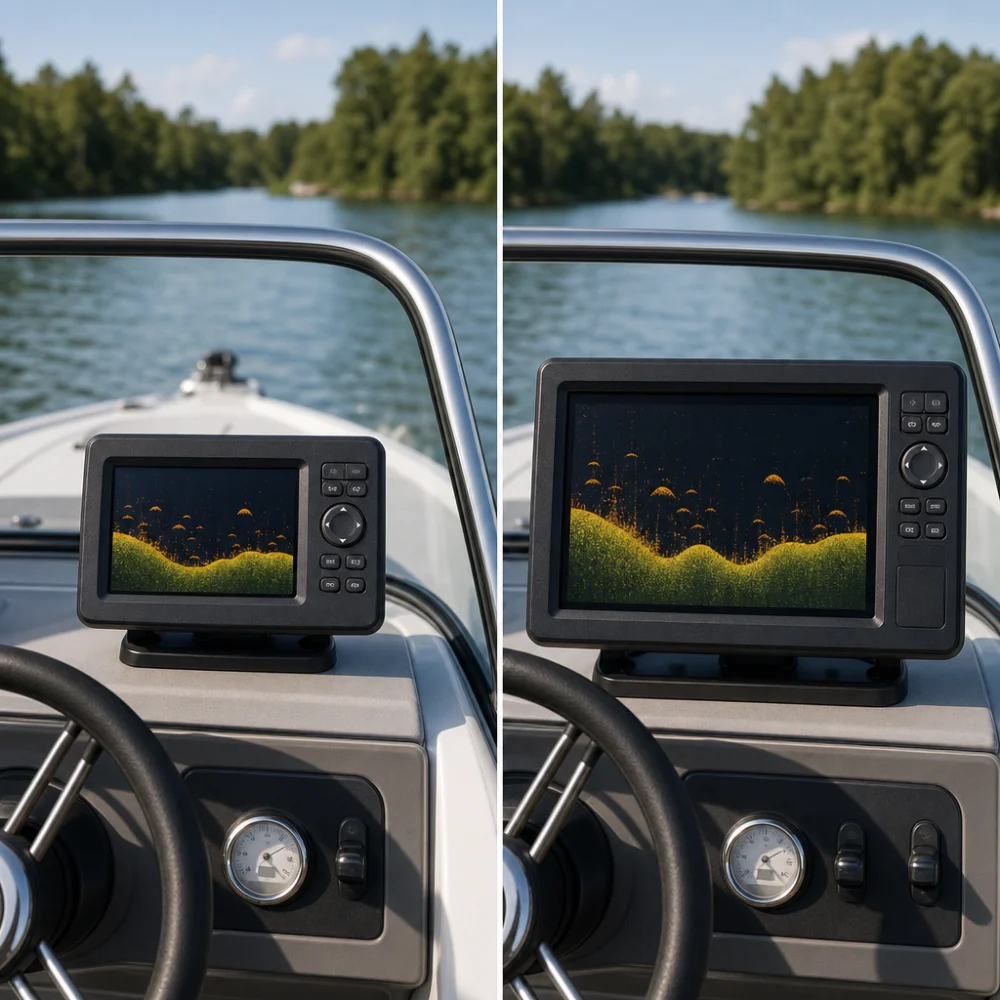
Which fish finder suits different buyers?
| Buyer need | Helpful characteristics | Trade-off to consider | What to verify |
|---|---|---|---|
| Small-boat or simple setup | Compact display, straightforward controls, easier mounting | Less screen space and fewer advanced features | Physical size, power needs, and mounting fit |
| Daytime visibility on the water | Readable screen, clear layout, larger display if space allows | Larger units can take up more helm room | Display size and how the interface is arranged |
| Anglers who want more detail | More capable sonar functions and a display that can show more information at once | Greater complexity and a higher learning curve | Which sonar features are included and how they are used |
| Replacement or upgrade buyer | Compatible transducer and installation fit | Existing gear may limit choices | Connections, mounting style, and supported accessories |
Common mistakes and misunderstandings
- Buying by screen size alone: A bigger screen can be easier to read, but it does not solve compatibility or installation issues.
- Assuming every fish finder is a complete package: Some products rely on separate parts or specific mounting choices, so check what is included.
- Overvaluing feature lists: Extra sonar terms do not help if the display is hard to see or the unit does not fit your boat.
- Ignoring the transducer: The transducer matters as much as the display for what the unit can actually do.
Safety and suitability caveats
A fish finder can improve awareness, but it is still only one navigation and fishing aid. It should be chosen as part of a sensible boat setup, not as a substitute for good judgment, local conditions, or other required marine equipment. Make sure the product page clearly matches your boat type, mounting space, and power setup before buying.
Maintenance, storage, and lifespan considerations
Marine electronics are exposed to moisture, sun, vibration, and handling, so long-term satisfaction often depends on basic care and storage. Consider whether the display is easy to protect when not in use, whether cables are likely to be stressed by your mounting position, and whether the unit will need any routine cleaning after saltwater use. If you fish seasonally, think about how simple it will be to remove or cover the equipment between trips.
How to compare fish finder options efficiently
- Start with your boat and fishing style, then decide whether you need a simple depth tool or a more feature-rich display.
- Check the display size and whether it will be readable from your normal helm position.
- Review the sonar and transducer details together, since they work as a pair.
- Confirm mounting, wiring, and available space before you compare extra features.
- Use the product page to verify the included parts and any compatibility notes.
Fish finder buyer checklist
- Is the display easy to read where it will be mounted?
- Does the sonar setup fit the type of fishing you do?
- Is the transducer included, and if not, is it compatible with what you already have?
- Will the unit fit your helm space and installation plan?
- Are the power and wiring requirements realistic for your boat?
- Does the feature set match your actual needs rather than just looking impressive?
Frequently asked questions
Do I need a large screen on a fish finder?
Not always. A larger screen can make data easier to read, especially in bright conditions or when you want multiple items visible at once, but compact units can work well on smaller boats or simpler setups. The right size depends on how much space you have and how you like to read information on the water.
Is the transducer included with every fish finder?
No, not necessarily. Some products include a transducer and others may require you to choose one separately, so this is one of the first details to verify. It is also important to confirm that any included sensor fits the way you plan to mount it.
What matters more: the display or the sonar?
Both matter, but they do different jobs. The display affects readability and ease of use, while the sonar and transducer determine what underwater information the unit can gather and present. For most buyers, the best choice balances both rather than excelling at only one.
Can a fish finder be added to a small boat?
Often yes, but the fit depends on mounting space, power access, and the type of transducer installation involved. Smaller boats may benefit from simpler units because they are easier to place and power. Checking those basics early can save a lot of comparison time.
Do I need advanced sonar features?
Only if they support the way you fish. Many buyers are better served by a straightforward unit that is easy to use and read than by a more complex model with features they will rarely use. Focus on the information that helps you make decisions on the water.
How do I compare fish finders without getting overwhelmed?
Start with the basics: display size, sonar capability, transducer fit, and installation needs. Once those are clear, compare any extra features only if they solve a real problem for your boat or fishing style. That approach keeps the choice practical and avoids paying for extras you may not use.